RustyData

Creative

Complexity you can hold in your hands

The hands-on side of the practice: hardware, playful machines and workshop builds that turn network and complexity science into things people can touch, play with and argue about.

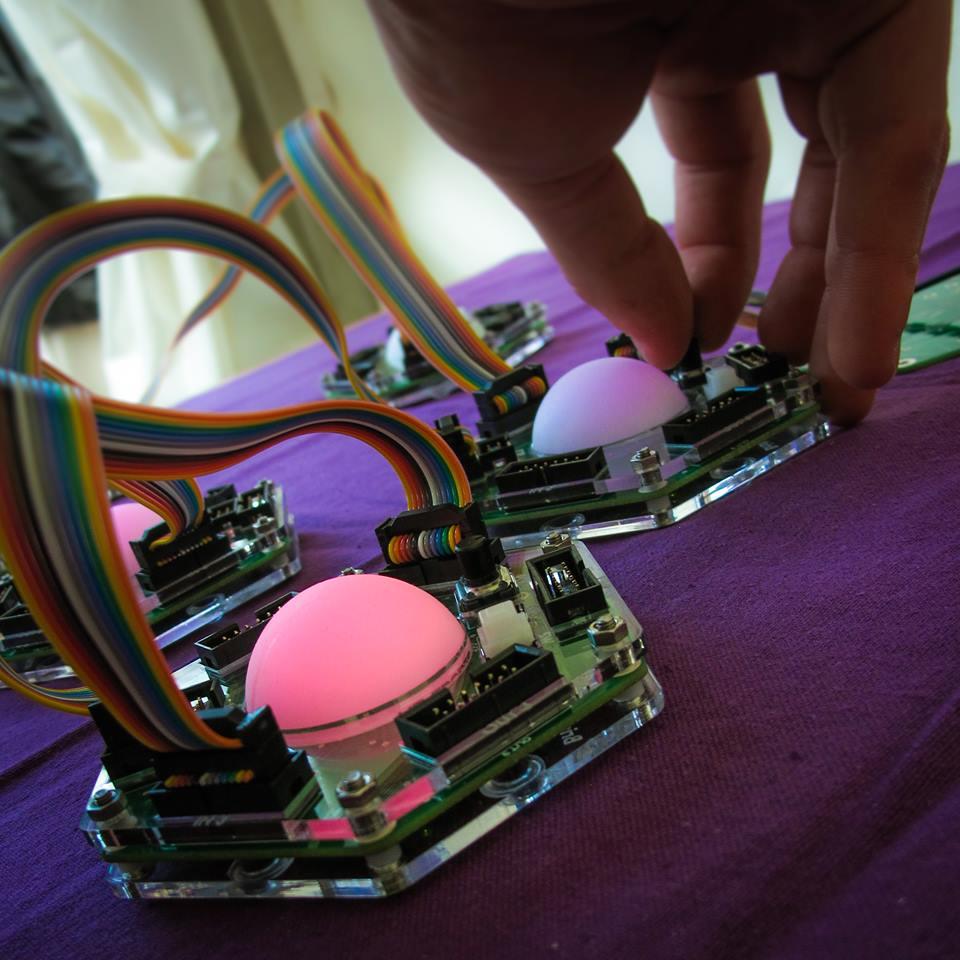
Close-up of Tangible Networks nodes on a purple cloth: hexagonal acrylic units with glowing pink and white domes, joined by rainbow ribbon cables, with a visitor's hand pressing a button.

Tangible Networks

An educational toolkit of hand-held, re-programmable electronic nodes that wire together into a real, living network — so a festival crowd can play with synchronisation, cascades and contagion instead of watching a slide about them.

I co-founded Tangible Networks in 2014 with fellow Bristol complexity-science researchers and Espen Knoop of the Bristol Robotics Lab. Each node is a device you can hold; connect them up and the collective dynamics of the network play out in light across the room. People don't watch a simulation — they become the network.

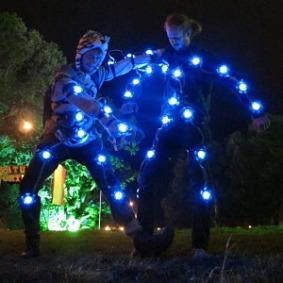
The toolkit was peer-reviewed (Tangible Networks: A Toolkit for Exploring Network Science, ECCS 2014, published by Springer), backed by RCUK schools-outreach funding, and travelled from the Green Man Festival to the New York Hall of Science — including an LED "neuron suit" for after dark.
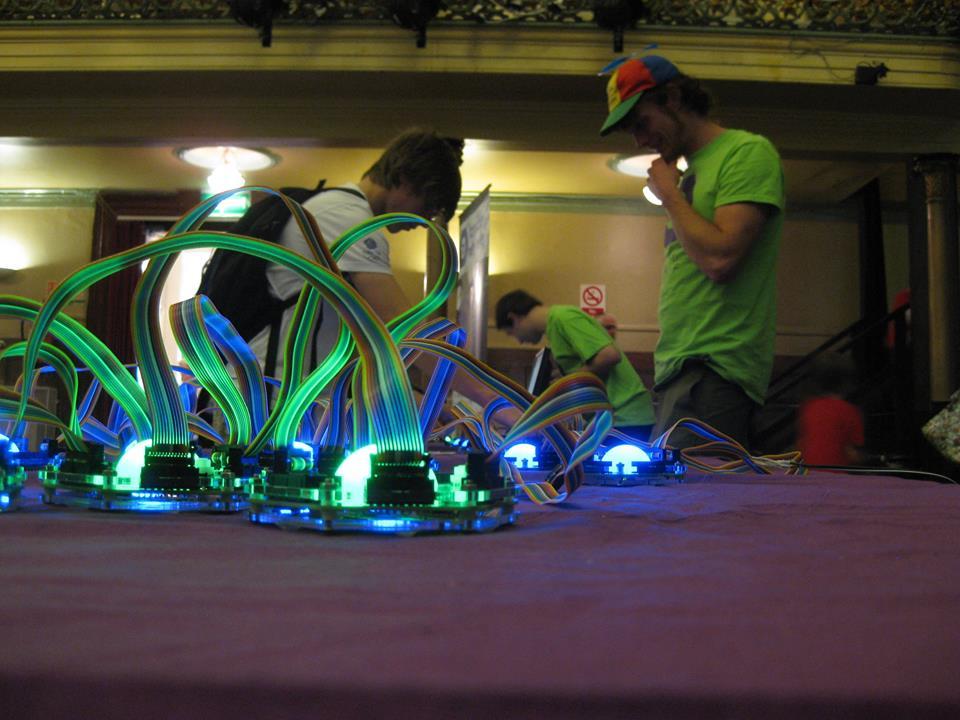
A table of Tangible Networks nodes glowing blue and green at a science festival, ribbon cables rising between them, with demonstrators in green project t-shirts behind.
Night shot at Green Man Festival: two people wearing 'neuron suits' — dark outfits strung with bright blue LED nodes.
  • Co-founded 2014
  • Peer-reviewed · ECCS 2014
  • New York Hall of Science
View the archived project site
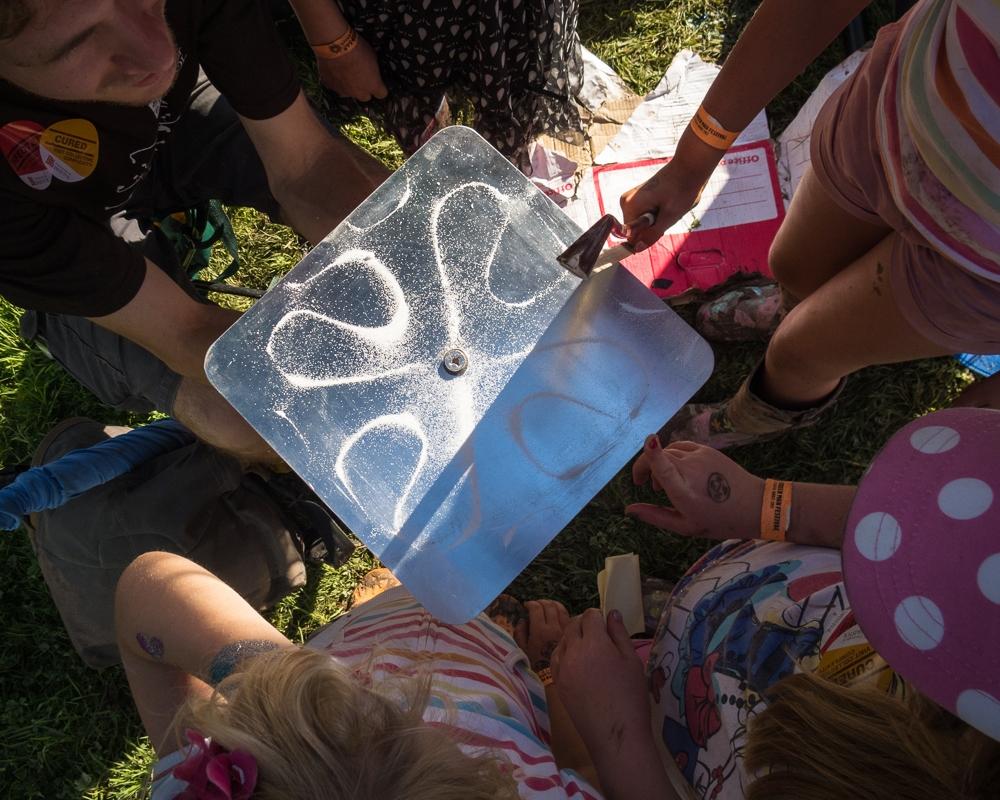
Overhead view of a square metal Chladni plate covered in white sand resonance patterns, with children and adults gathered around it on festival grass.

Collective Complexity

The Bristol Centre for Complexity Sciences' public-engagement banner: hands-on experiments — DNA extraction, cryptography, vortex cannons, Chladni plates — taken to festivals and schools.

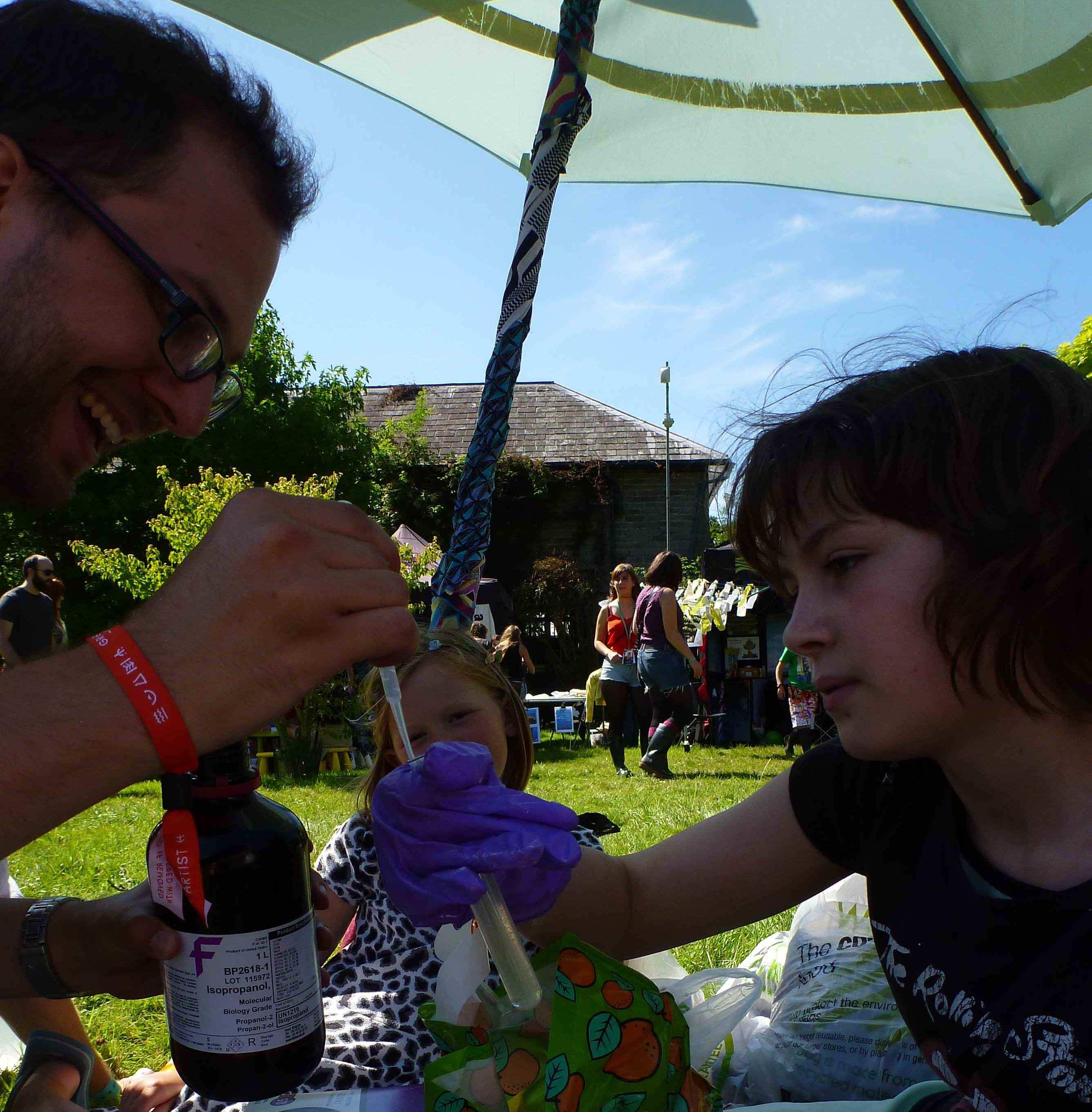
As co-chair of the BCCS outreach committee (2013–2015) and joint lead on a £10K engagement award, I helped take complexity science to general audiences — extracting DNA from strawberries at Green Man, drawing standing waves in sand, and running demos in local schools, often alongside Tangible Networks.

The guiding belief, in my own words from the time: public engagement is about empowerment. Complexity science describes the systems people live inside every day, so everyone deserves access to its ideas.

Outdoor festival demo under a parasol: a demonstrator pipettes isopropanol while two children in purple gloves hold a test tube, extracting DNA from a strawberry.
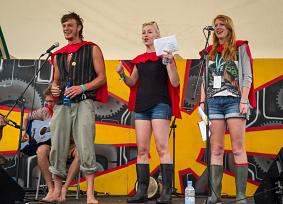
Three performers on a festival stage — one in a red cape, two in wellies reading lyrics — performing 'Physics Lab Blues' live.
  • BCCS · University of Bristol
  • 2013–2015
  • Green Man Festival
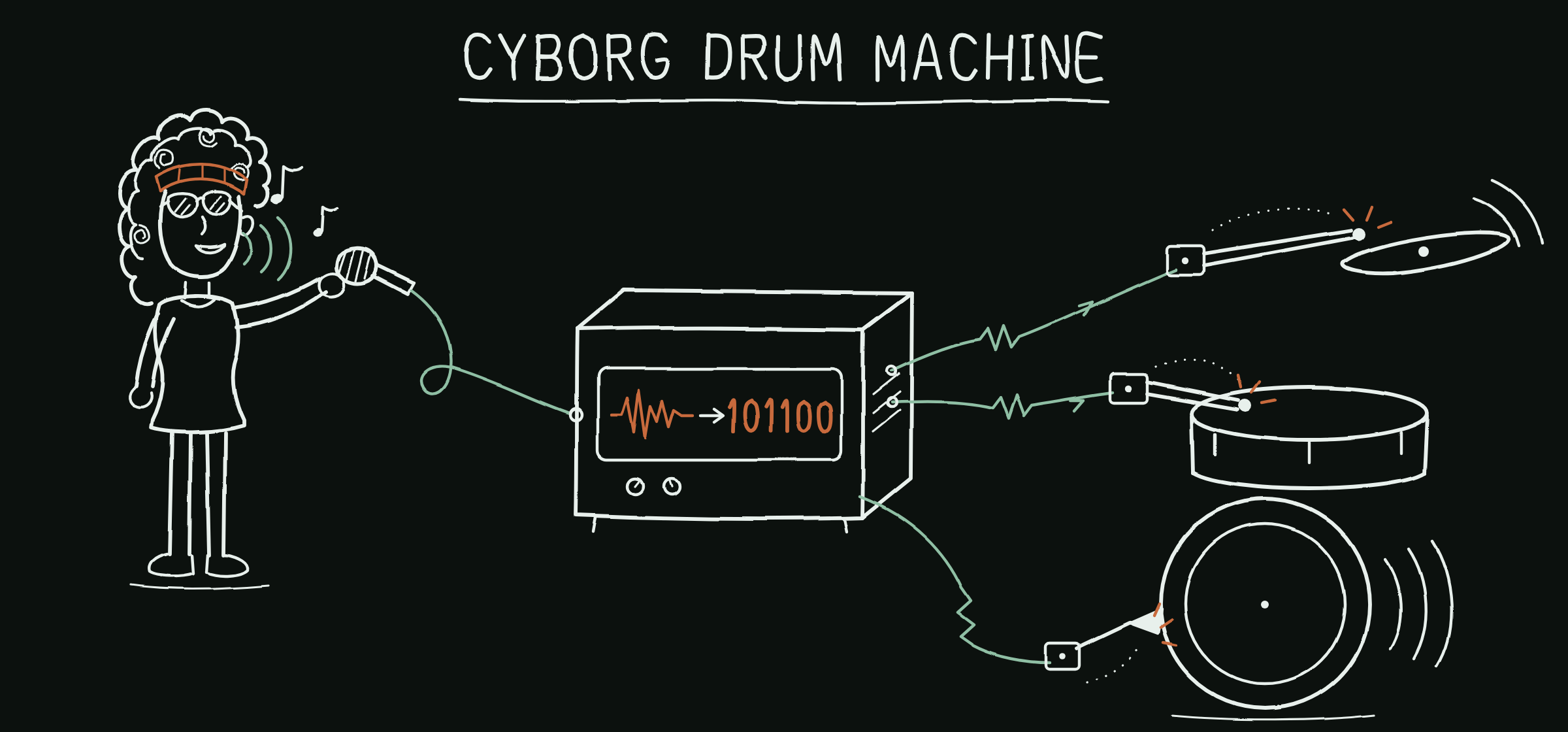
Hand-drawn schematic titled 'Cyborg Drum Machine': a person sings into a microphone, a converter box turns the sound waveform into binary ('101100'), and wired mechanical arms strike a drum kit.

Cyborg Drum Machine

A playful human–machine instrument: beatbox into a microphone, the box turns your waveform into binary, and a real drum kit plays it back. Part signal processing, part performance, all fun.

  • Illustrated schematic
  • Voice → binary → drums

Also in the workshop

Not everything survives on camera. A running series of hands-on builds and physics toys — made for the joy of making, and for showing people how things work.

  • A Rubens tube — standing sound waves drawn in a line of flame
  • A Chladni plate for singing sand into resonance patterns
  • Giant smoke-vortex cannons for festival crowds
  • An Arduino-powered automatic halloumi maker
  • A thermostatic brewing jacket, also on Arduino

Why this belongs here

These projects are not a sideline from the consultancy — they are the same skill pointed at a different audience. Explaining a model to a nine-year-old is excellent training for explaining one to a board.