Organisational design · Research platform
SuperScript — reinforcement learning for team allocation
A multi-year research platform pairing an agent-based model of team formation in project-based organisations with a suite of team-allocation optimisers — including hierarchical reinforcement learning — benchmarked head to head across organisational scenarios.
The problem
Allocating people to teams in a project-based organisation looks like a scheduling puzzle but behaves like an ecosystem. Skills, availability, project requirements and team chemistry all interact — and every allocation reshapes the organisation that receives the next one. Most allocation research stops at the first question: which assignment scores best right now? SuperScript was built to ask the harder second one: what kind of organisation does each allocation method build over time?
The platform
At the core is SuperScript itself: an agent-based model of team formation in project-based organisations, built with Mesa. Simulated workers carry skill profiles; projects arrive continuously; teams are assembled, deliver or fail, and the workforce evolves in response.
On top of the model sits a suite of six team-allocation optimisers, benchmarked head to head: Random and Greedy baselines, GRASP, mixed-integer linear programming (solved with SCIP), hierarchical reinforcement learning — a higher-level worker-and-team-selection policy (RLD2) sitting over a lower-level hard-skill allocator (RLD1), trained with Gymnasium and Stable-Baselines3 PPO — and an Ensemble combining methods.
What the experiments show
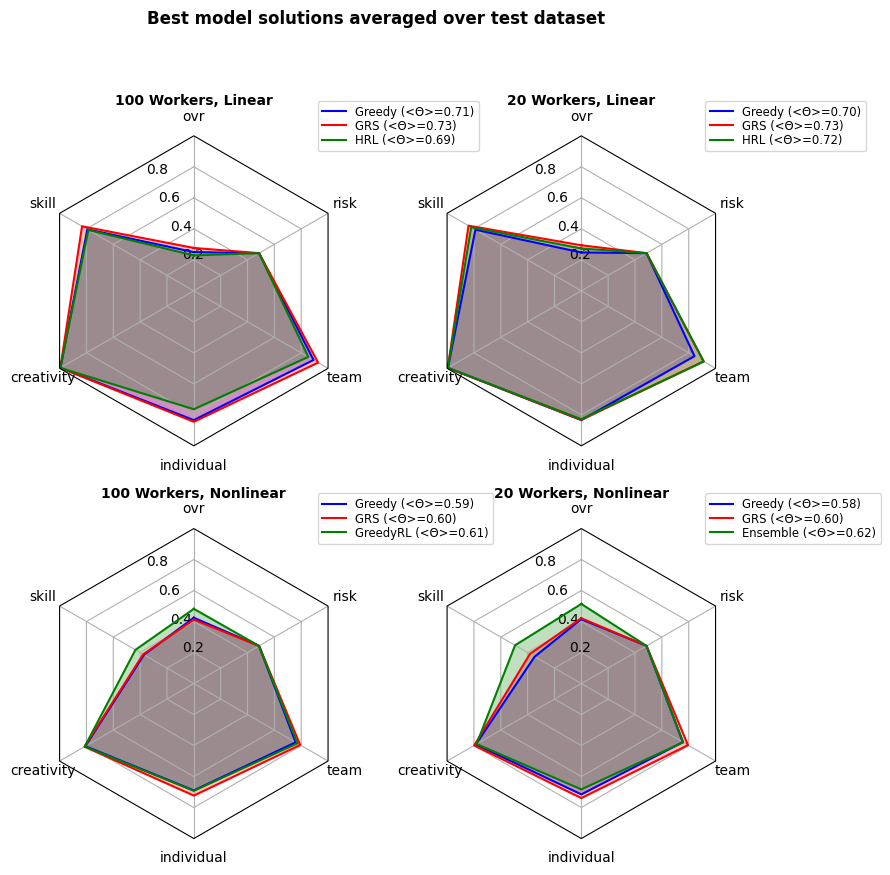
Run across scenarios — linear and nonlinear project-success functions, organisations of 20 and 100 workers — the optimisers reach strikingly similar short-term success scores. The interesting differences are structural: methods with near-identical scores assemble very different teams, and over time produce very different organisations. Team allocation, in other words, is organisational design.
The platform is open: three public repositories carry the agent-based model with its optimisers, the RL environments with trained policies, and the full experiment suite — including a golden regression suite that verifies the results reproduce. A journal article is in preparation.